Overview
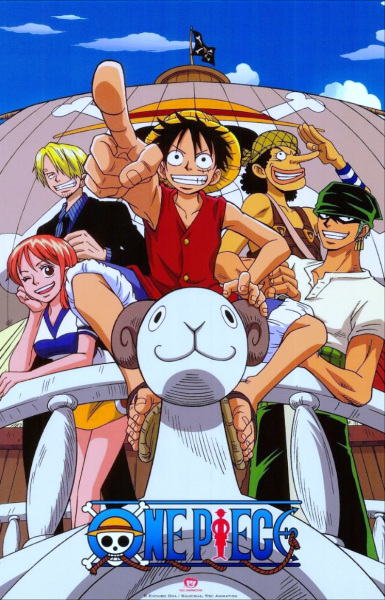
Barely surviving in a barrel after passing through a terrible whirlpool at sea, carefree Monkey D. Luffy ends up aboard a ship under attack by fearsome pirates. Despite being a naive-looking teenager, he is not to be underestimated. Unmatched in battle, Luffy is a pirate himself who resolutely pursues the coveted One Piece treasure and the King of the Pirates title that comes with it.
The late King of the Pirates, Gol D. Roger, stirred up the world before his death by disclosing the whereabouts of his hoard of riches and daring everyone to obtain it. Ever since then, countless powerful pirates have sailed dangerous seas for the prized One Piece only to never return. Although Luffy lacks a crew and a proper ship, he is endowed with a superhuman ability and an unbreakable spirit that make him not only a formidable adversary but also an inspiration to many.
As he faces numerous challenges with a big smile on his face, Luffy gathers one-of-a-kind companions to join him in his ambitious endeavor, together embracing perils and wonders on their once-in-a-lifetime adventure.
[Written by MAL Rewrite]
Themes and Genres
One Piece is classified under Action, Adventure and Fantasy, and much of its appeal comes from how confidently it commits to those genre foundations. Rather than treating genre as a marketing label, the series uses it as a structural backbone: pacing, character arcs, and visual language are all shaped around what fans of Action, Adventure and Fantasy typically look for. Viewers drawn to this corner of anime tend to value strong emotional stakes, memorable character dynamics, and a sense that the world being depicted has its own internal logic worth exploring. One Piece leans into that expectation, giving both newcomers and longtime genre fans a clear sense of what kind of story they are stepping into from the very first episode. The genre framing also shapes how the story is discussed within the community — discussions around One Piece frequently reference how it stacks up against other well-known Action, Adventure and Fantasy titles, which has helped keep it part of the broader conversation long after individual episodes first aired.
Beyond the surface-level classification, Action, Adventure and Fantasy also inform the pacing choices made throughout One Piece. Series in this space tend to alternate between quieter character-focused stretches and higher-intensity moments designed to pay off the setup that came before, and that rhythm is part of what keeps long-running discussions and rewatches alive within the fan community. It is also common for Action, Adventure and Fantasy titles to age differently than other anime — some lean heavily on trends specific to their release era, while others establish a tone and approach that later series continue to reference. Where One Piece lands on that spectrum is part of what makes it a useful reference point whenever fans compare newer Action, Adventure and Fantasy releases against titles that came before them.
Behind the Production
One Piece was produced by Toei Animation as a TV series, releasing in 1999 with an ongoing episode count. Studio choice matters a great deal in anime production, since it often signals a particular visual approach, animation pipeline, and level of investment in adapting the source material faithfully. Toei Animation brought their own production sensibilities to One Piece, and the result is a title that fans and critics alike have used as a reference point when discussing that studio's body of work. The 1999 release places One Piece within a specific moment in the broader anime industry, alongside whatever trends, technical standards, and audience expectations were dominant at the time. Understanding that context helps explain some of the stylistic and structural choices found throughout the series.
Format also plays a role in how One Piece is experienced. As a TV series spanning an ongoing episode count, it has a particular rhythm to how the story is paced out and released, which shapes both how it was originally watched week-to-week (or in one sitting, depending on format) and how newer viewers approach it today. Anime distributed in this format often develop a specific kind of community engagement, with viewers discussing individual installments as they go rather than waiting to react only once the full story is available.
Reception and Rating
One Piece is currently airing new episodes and holds a community rating of 8.73 out of 10 based on aggregated audience scores. A rating in this range typically reflects a title that has resonated strongly with a broad segment of the anime-watching community, standing out not just among Action, Adventure and Fantasy titles specifically but within the wider medium. Ratings like this are usually built up over time as more viewers watch, discuss, and revisit the series, which speaks to a certain staying power beyond its initial release. It is worth noting that community scores are a snapshot of aggregate opinion rather than a definitive verdict — plenty of viewers connect with anime that scores differently, and personal taste always plays the biggest role in how any individual experiences a series. Still, 8.73 is a meaningful data point for anyone deciding whether One Piece might be worth their time.
Aggregated community ratings like this one also tend to be self-reinforcing to some degree: a strong score encourages more viewers to try a series, and those additional viewers then contribute their own ratings, which either confirms or adjusts the overall consensus over time. A rating of 8.73 for One Piece suggests that this feedback loop has, on balance, worked in its favor, with enough consistent positive reception across a large enough sample of viewers to keep the number stable at a level generally considered strong within the anime community.
Legacy and Ongoing Appeal
Anime titles that stay relevant years after release usually share a few traits: a clear genre identity, dependable production quality, and a story that gives fans something worth discussing. One Piece checks each of those boxes. Its grounding in Action, Adventure and Fantasy, the craftsmanship brought by Toei Animation, and a run of an ongoing episode count that gives the story room to develop all contribute to why it continues to come up in recommendation threads and genre retrospectives. Whether someone is a longtime fan of Action, Adventure and Fantasy anime looking for another title to add to their list, or a newcomer trying to understand why One Piece keeps getting mentioned, the series offers a fairly representative — and well-regarded — example of what this corner of anime has to offer.
The ongoing appeal of One Piece also owes something to how well it introduces new viewers to Action, Adventure and Fantasy as a category. Titles that function well as an entry point tend to have a longer cultural half-life than those that only appeal to viewers already deeply familiar with a genre's conventions, and One Piece has generally been discussed as accessible in exactly that way — a series that can be recommended broadly rather than only to a narrow audience.
Who Should Watch This
One Piece is a reasonable starting point for viewers curious about Action, Adventure and Fantasy, and it also holds up as a recommendation for anyone already familiar with the space looking for a well-regarded, an ongoing episode count-long series from Toei Animation. Its 1999 release and TV series format mean it fits comfortably into most viewing habits, whether that means working through it steadily or in a more concentrated binge. As with any anime recommendation, individual taste plays a large role, but One Piece's combination of genre clarity, production quality, and community reputation makes it a low-risk, high-reward addition to most watchlists.