Overview
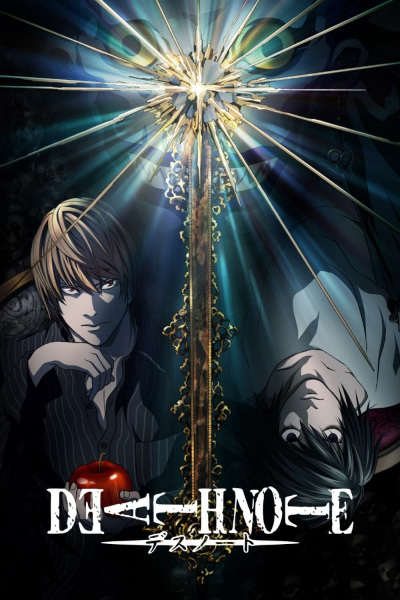
Brutal murders, petty thefts, and senseless violence pollute the human world. In contrast, the realm of death gods is a humdrum, unchanging gambling den. The ingenious 17-year-old Japanese student Light Yagami and sadistic god of death Ryuk share one belief: their worlds are rotten.
For his own amusement, Ryuk drops his Death Note into the human world. Light stumbles upon it, deeming the first of its rules ridiculous: the human whose name is written in this note shall die. However, the temptation is too great, and Light experiments by writing a felon's name, which disturbingly enacts his first murder.
Aware of the terrifying godlike power that has fallen into his hands, Light—under the alias Kira—follows his wicked sense of justice with the ultimate goal of cleansing the world of all evil-doers. The meticulous mastermind detective L is already on his trail, but as Light's brilliance rivals L's, the grand chase for Kira turns into an intense battle of wits that can only end when one of them is dead.
[Written by MAL Rewrite]
Themes and Genres
Supernatural and Suspense sit at the heart of Death Note, and that classification says a lot about what to expect tonally and structurally. Genre in anime is rarely just a label; it is a promise about pacing, character focus, and the kind of payoff a story is building toward. Death Note follows through on that promise, using the conventions of Supernatural and Suspense as a foundation rather than a constraint. For fans who already gravitate toward this space, the series offers familiar comforts executed with care. For newcomers, it can serve as an accessible entry point into why Supernatural and Suspense continue to resonate with anime audiences worldwide. The way Death Note balances genre expectations with its own identity is a large part of why it remains a frequent reference point in genre-specific discussions and recommendation lists.
It also helps to consider Death Note alongside the wider catalog of Supernatural and Suspense anime rather than in isolation. Genre communities tend to build shared vocabulary and expectations over time — certain pacing choices, character archetypes, or narrative beats become associated with doing Supernatural and Suspense well, and titles get measured against that informal standard. Death Note is frequently brought up in exactly those comparisons, which is one of the clearer signs that it has found a lasting place within its genre space rather than fading after its initial release window.
Behind the Production
Production on Death Note was handled by Madhouse, resulting in a TV series format spanning 37 episodes, first releasing in 2006. The studio behind any anime shapes far more than just the artwork — it influences pacing decisions, how faithfully a story adapts its source material, and the overall visual identity the series ends up with. Madhouse approached Death Note with a level of craft that has since become part of how the series is remembered and discussed. Looking back at the 2006 release window also offers useful context: anime production trends, animation techniques, and audience tastes shift over time, and Death Note reflects the particular moment in the industry when it was made.
The choice to release Death Note as a TV series with 37 episodes also reflects a deliberate structural decision. Some stories are better suited to a longer, more gradual format that allows characters and world-building room to breathe, while others benefit from a tighter, more contained run. Where Death Note falls on that spectrum has a direct effect on pacing, and understanding that structural choice can make the overall experience of watching it feel more intentional rather than arbitrary.
Reception and Rating
Death Note has completed its run and holds a community rating of 8.62 out of 10 based on aggregated audience scores. A rating in this range typically reflects a title that has resonated strongly with a broad segment of the anime-watching community, standing out not just among Supernatural and Suspense titles specifically but within the wider medium. Ratings like this are usually built up over time as more viewers watch, discuss, and revisit the series, which speaks to a certain staying power beyond its initial release. It is worth noting that community scores are a snapshot of aggregate opinion rather than a definitive verdict — plenty of viewers connect with anime that scores differently, and personal taste always plays the biggest role in how any individual experiences a series. Still, 8.62 is a meaningful data point for anyone deciding whether Death Note might be worth their time.
Aggregated community ratings like this one also tend to be self-reinforcing to some degree: a strong score encourages more viewers to try a series, and those additional viewers then contribute their own ratings, which either confirms or adjusts the overall consensus over time. A rating of 8.62 for Death Note suggests that this feedback loop has, on balance, worked in its favor, with enough consistent positive reception across a large enough sample of viewers to keep the number stable at a level generally considered strong within the anime community.
Why Fans Keep Coming Back
What keeps a series like Death Note in ongoing conversation long after its initial release is rarely just one factor. It is usually a combination of a strong premise, consistent execution, and a genre identity that gives viewers a clear reason to recommend it to others. Death Note benefits from all three: a setup rooted in Supernatural and Suspense that is easy to describe to a newcomer, production values from Madhouse that hold up on rewatch, and a structure across its 37 episodes that rewards viewers who stick with it. For anyone building out an anime watchlist, Death Note represents a reasonably safe recommendation within the Supernatural and Suspense space — accessible enough for newcomers, distinctive enough to hold the attention of more experienced viewers.
Rewatch value is another factor worth mentioning. Many long-time fans return to Death Note specifically because a second viewing often reveals pacing and character choices that are easy to miss the first time through, particularly once the overall shape of the story is already known. That kind of durability — being worth revisiting rather than only worth watching once — is one of the clearer indicators of a title's lasting place within the Supernatural and Suspense space.
Getting Started With This Series
For viewers deciding whether to add Death Note to their watchlist, the short version is straightforward: fans of Supernatural and Suspense are likely to find exactly what they are looking for, and newcomers to the genre will find Death Note to be an approachable, well-produced introduction thanks to the work of Madhouse. Spanning 37 episodes as a TV series released in 2006, it offers a self-contained viewing commitment without requiring familiarity with any wider franchise, which makes it a straightforward recommendation for anyone building out their anime backlog.